Digital-Desert : Mojave Desert Photography by Walter Feller
Mojave Desert Photos for Sale
features - ecology: wildlife - plants - places - region map - map/sat - roads & trails - wilderness - video - aerial - 360 photos - old west - communities - books - lodging
route 66 - ghost towns - gold mines - parks & ... - joshua tree - death valley - mojave preserve - native culture - history - natural features - geology - glossary - comments
Desert & Mountain
Fine Art Photo Prints

Mojave Desert Indians

>> MAP

For millennia, American Indian peoples lived within the area, using the resources and lands to sustain their lives and cultures. These lands have been and continue to be subject to active, often dramatic, and ever-changing natural forces that can alter water supplies, change vegetation zones, make new landforms from tectonic or volcanic events, and include cutting or filling geological processes. Climatic changes that have occurred since the end of the Ice Age have altered moisture in lakes and marshes, affected animal populations and plant life, and challenged humans to adapt. This area is characterized by a series of parallel, northward-draining trough-like valleys between north-south oriented mountain systems that form rain shadows, resulting in more evaporation than precipitation and general aridity. The basic necessities for human life of American Indian peoples are present – water and food, materials for tools, access to routes for traveling, special places for spiritual rites that continue today, and a sense of land association and place identity. These peoples’ presence has resulted in a tangible heritage of cultural materials, remembered place names and associations, and attachments to the land from history to modern times.

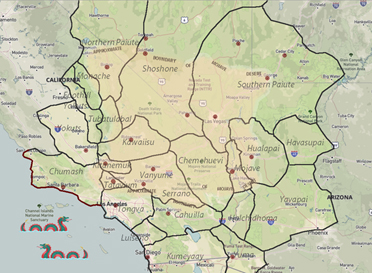
Nonnative people describe lands as typical of the Great Basin geomorphic province and of the Sonoran-Mojave Deserts in biological terms. From valley floors to mountain peaks, a series of environmental zones is described from lower elevation scrub plant communities, through Joshua Tree and pinyon-juniper woodlands, to higher elevations of mixed pine and pinyon woodlands. The valleys often contain dry lakes or playas. Transitional foothill zones are cut by drainage systems, forming seeps, springs, and active seasonal streams. To American Indian peoples now known as Mohave, Shoshone, Paiute, Serrano, Chemehuevi, and Kawaiisu, the lands were occupied and used in many ways, with flexible boundaries among these tribal groups. These peoples are differentiated by language, varied subsistence patterns, and self-identification. Specific historic geographical associations to the planning area and places are known from compilations of information used in Federal Indian Land Claims court cases during the l950s and l960s.

In general, tribal peoples historically occupied their lands in small, mobile social units of related families who traveled in regular patterns, establishing summer or winter camps in customary places with water supplies, often located at a border between scrub or woodland zones. Some localities contained richer and more dependable food resources than others, but the lands did not support large numbers of persons at any one location. Many plants yielded seed, nut, tuber, or fiber foods, prepared for consumption or for storage at convenient caches. Large or small land mammals were hunted or caught, birds such as doves or quail were snared, and reptiles were collected, but not all plants or fauna were sought. The diet for these native peoples was largely vegetarian, supplemented by mammals, reptiles, and insect sources. Certain places on the lands were and are today considered specially significant; for example, landforms named in oral accounts of travels by supernatural beings, "hot" springs that have curative purposes, petroglyph sites believed to be the products of the shamans’ supernatural helpers, or topographic landmarks identified in complex chants known today as "bird songs." In essence, "oral maps" of the planning area still exist today in ceremonial knowledge held by certain Mohave and Chemehuevi individuals. Other tribal members have documented descriptive names in Shoshone language for places of settlement, gathering camps, and other important locations in the study area.

In the past two centuries American Indian peoples inhabiting the area have changed their territorial ranges in reaction to European and later American direct and indirect pressures, as well as intertribal struggles. U.S. military presence increased at Camp Cady, east of Mojave National Preserve, at established posts in the Owens Valley and at Fort Mohave along the Colorado River in response to increasing American settlers, miners, and ranchers. This resulted in establishment of more concentrated reservations and communities by the early 20th century. Earlier movements were caused by groups of families moving toward growing towns, shifting populations from more traditional scattered patterns. For example, from the southern Nevada portion of Southern Paiute-held areas, people now known as Chemehuevi had moved toward the Colorado River valley early in the 19th century. Kawaiisu, Koso (also known as Panamint Shoshone) and Serrano peoples were jointly using terrain around the Granite and Providence Mountain ranges during the 19th century.

Also see:

Prehistoric Cultures of Death Valley

During the Pleistocene Era, a period that witnessed a cool, moist climate south of the continental ice sheets, these ...

Tribes of the 35th Parallel

Let us accompany Messrs. Whipple and Ives, for the sake of some new and curious acquaintance-for which we shall be ...

Ethnohistory

Ethnohistory is a field of study that blends archaeology, ethnology, and history, using ...

Desert Indian Languages

The languages of the Indians in the Mojave Desert are rooted in two basic groups, that of ...

Paiute & Shoshone Cultures of Death Valley

For millennia, American Indian peoples lived within the area, using the resources and lands to sustain their lives and cultures. These lands have ...

Indians of the Eastern Mojave

In general, these tribal peoples occupied the lands as small, mobile social units of related families who traveled in regular patterns and established summer or winter camps in customary places ...

Paleo-Indians, Pinto Culture

As the Pleistocene Epoch drew to a close ten thousand years ago, and the rivers of glacial ice melted, people lived in an environment dramatically different from ...

How Indians Used Plants

In the desert, Indians found native plants and other natural objects that not only ensured their survival but also ...

Historical Sketch of the California Indians

This sketch covers five major time periods in California history. They are the following natural divisions: the time prior to European contact, the period ...

Indian Slave Trade

The Indian slave trade in the desert was brutal and often deadly.


Mohave

Eastern Mojave/Colorado River: Their life centered around the river. They relied on annual overflow to irrigate their crops of ...

Chemehuevi

Eastern & Southern Mojave: The Chemehuevi territory lay off the lower Colorado River north and west toward Death Valley and ...

Cahuilla

Southern Mojave & Northern Colorado: The Cahuillas hunted with throwing sticks, clubs, nets, traps, dead falls with seed triggers, ...

Serrano

Southern & Western Mojave: Each clan was composed of lineage sub-units, each of which had its own territorial base ...

    Vanyume

    Western & Southern Mojave: The Vanyume were the desert Serrano. They ranged along the ...

Tataviam

Western Mojave and San Gariel Mountains: The Tatavium lived in the vicinity of Vasquez Rocks ...

Kitanemuk

Western Mojave: The Kitanemuk were dependant on acorns from the abundant oak in the western ...

Kawaiisu

Northern Mojave: Being hunter-gatherers, the Kawaiisu roamed their territory in search of ...

Tubatulabal

Northern Mojave: The degree to which the Tubatulabal language diverges from ...

Western Mono

Northern Mojave: Like other remotely located tribes in California, their population has ...

Koso

Northern Mojave: The Koso lived in the area east of the crest of the Sierra, south of ...

Southern Paiute

Historically, the largest population concentrations of Paiutes were along the ...

    Owens Valley Paiute

    Owens Valley: Within these tribal territories were a number of villages. In winter the people ...

Shoshone

North Mojave: Western Shoshoni occupied what is today northern and western Nevada. ...

    Timbisha Shoshone

    Death Valley: Mesquite trees were always a focal point of Timbisha culture. Tribal members would ...

Yokuts

They are subdivided into tribes, each numbering two to three hundred persons, and ...


Arizona

Hualapai
Havasupai
Halchidoma
Yavapai
Maricopa

A scout for the U.S. Railroad Survey in 1853 reported that “A mountain range extends from San Bernardino Mountain in a southeasterly direction nearly, if not quite, to the Colorado. Between these mountains and the mountains of the Mohave nothing is known of the country. I have never heard of a white man who had penetrated it. I am inclined to the belief that it is barren, mountainous desert composed of a system of basins and mountain ranges. It would be an exceedingly difficult country to explore on account of the absence of water and there is no rainy season of any consequence.”

"Lo! The poor Indian, whose untutor'd mind/Sees God in the clouds, or hears him in the wind...". -- Alexander Pope, Essay on Man.

Petroglyph Site Photos
Pictures of petroglyphs at sites throughout the Mojave Desert

Petroglyphs
The rock art of the Mojave Desert Native Americans


Coyote Tails
Tales of Brother Coyote
??? Clever Trickster - Bungler ???
features - ecology: wildlife - plants - places - region map - map/sat - roads & trails - wilderness - video - aerial - 360 photos - old west - communities - books - lodging
route 66 - ghost towns - gold mines - parks & ... - joshua tree - death valley - mojave preserve - native culture - history - natural features - geology - glossary - comments
SkiWrightwood
Southern California Ski Reports

Wrightwood California
A year-round mountain community
HighDesertRED.com
High Desert Real Estate Directory
--
Google
Search:
Keywords:
Check out our...
>> RECOMMENDED BOOK LISTS <<
Digital-Desert
Abraxas Engineering
privacy
Copyright ©Walter Feller. All rights reserved.
Respect U.S and international copyright statutes and our right to own and control our work
- DO NOT LINK TO THESE IMAGES FROM WEB PAGES, FORUMS OR BLOGS -
Desert Gazette
42260