Kawaiisu Indians
The Kawaiisu were a small Native American group who lived in the Tehachapi Mountains and surrounding regions of southern California. Their main village site, Tomo-Kahni (meaning "Winter Home"), sat on a ridge overlooking Tehachapi Valley and provided access to diverse natural resources. Their population likely fluctuated between a few hundred and about one thousand depending on environmental conditions.Archaeological evidence suggests human presence in the region for at least 3000 years, though the Kawaiisu themselves appear to have occupied the area for roughly 1500 years. Their movements may have been influenced by climate shifts, including cooling and warming periods that affected settlement patterns across the Southwest.
The first written reference to the Kawaiisu comes from the 1776 journal of Francisco Garces, who encountered them during an expedition. By the mid 19th century, increasing American settlement led to displacement. Government relocation efforts, supported by figures like Edward Beale, forced many into reserves such as Tejon Pass, accelerating cultural disruption and assimilation.
Linguistically, the Kawaiisu spoke a Southern Numic language within the Uto-Aztecan language family. Despite being surrounded by different language groups, their closest relatives were the Chemehuevi to the east.
Their society was organized around small family groups rather than rigid hierarchies. Leadership was informal, based on knowledge and generosity rather than authority. Marriage was typically monogamous and flexible, and social cohesion depended on kinship, shared traditions, and trade networks.
Economically, the Kawaiisu were hunter gatherers with a strong emphasis on environmental knowledge and sustainability. Acorns were a staple food, supplemented by seeds, berries, roots, and game such as deer. They practiced resource management techniques like replanting and controlled burning to maintain ecological balance.
Housing included dome shaped winter dwellings (tomo kahni), summer shade structures, sweathouses, and temporary shelters. Their material culture was highly developed, especially in basketry, which served practical and ceremonial functions. Tools were made from stone, bone, and plant fibers, and trade provided materials like obsidian.
Clothing was simple and made from animal skins and plant materials. Cultural life included games, music, and storytelling, particularly during winter. Their belief system was animistic, viewing all elements of nature as alive and interconnected.
Mythology, often referred to as the "Coyote Cycle," featured Coyote as a complex figure embodying human traits, while Mountain Lion represented wisdom and correct judgment. These stories conveyed moral lessons and reinforced respect for nature.
Rock art in the form of pictographs is present throughout their territory. The Kawaiisu attribute these images to a supernatural entity known as "Rock Baby," reflecting their spiritual interpretation of the landscape.
Overall, the Kawaiisu culture was deeply rooted in environmental awareness, social cooperation, and oral tradition, representing a way of life closely tied to the land and its rhythms.
Great Basin, Tehachapi, hunter-gatherers, territory, plants and for the animals that lived there.
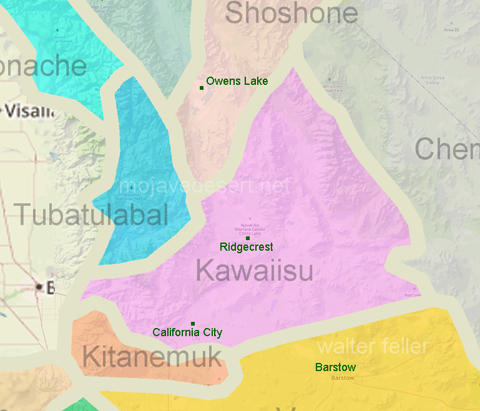
Kawaiisu Indian Territory
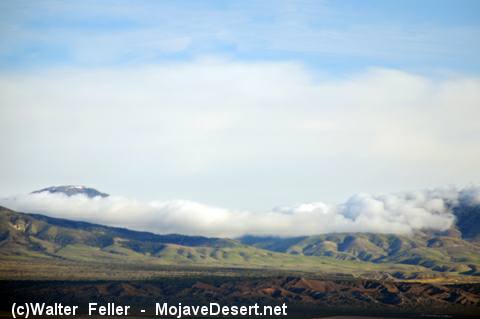
Kawaiisu territory
http://www.sacred-texts.com/nam/ca/ric/ric01.htm