History
Reservations
Reservations began to be established for Cahuillas in the 1870s. The nearest of these
to the
Joshua Tree National Park
was Morongo Indian Reservation, first permanently established in 1877. Although
it had been intended as a home for all the Shoshonean-speaking Indians of southwestern California, it was
the Cahuillas and Serranos who became its residents. Over the years people there have maintained a fairly
close relationship with the Indians who used and occupied the area now set aside as the park. Clara True,
the Indian agent who was most interested in the Twentynine Palms Reservation, had her main office at Morongo, from
which she traveled by buggy to visit the people at
Twentynine Palms.
Twentynine Palms people have also interacted often with the Cahuillas at Tones-Martinez Indian Reservation, Augustine
Indian Reservation, Cabazon Indian Reservation, and Agua Caliente Indian Reservation-all in the Coachella Valley,
and came to share a reservation with those at Cabazon, as we have noted. Los Coyotes Indian Reservation, Santa Rosa
Indian Reservation, Cahuilla Indian Reservation, and Ramona Indian Reservation, for the most part in the Santa
Rosa mountains, are also Cahuilla reservations. These reservations, for good and ill, have had considerable
attention from Mission Indian agents over the years. There were reservation schools on most of them until
about 1915 when Indian children were allowed to go to public schools. Sherman Institute, founded about the
turn of the century, was also available to them, as was St. Boniface School in Banning, the latter operated
by the Catholic Church.
Beginning in the early years of the twentieth century, the Indian Irrigation Service (IIS) began to build
irrigation systems on a number of reservations set aside for the Cahuilla, including Torres-Martinez, Agua
Caliente, Morongo, Santa Rosa, and Cahuilla reservations. To some extent, these systems accomplished their
purpose of improving the agricultural potential of reservation lands, but the IIS was persistently
underfunded, and never managed to keep its irrigation systems in good enough condition to make agriculture
a feasible means for Indians to earn a living. By the 1920s, farming was already taking second place to
wage labor.
Introduction
Material Culture, Technology
Trade, Exchange, Storage
Social Structure
Religion
History
Timeline
Traditional Territory
Major Sources
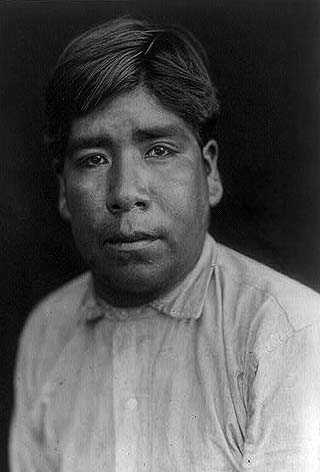
Cahuilla man from Palm Springs