Religion - Spiritual Reciprocity
Reciprocity was an important value in Cahuilla rules for living. Not only were humans to give and
receive freely in relationships with each other, but "humans were to reciprocate with supernatural
powers to maintain the world order," with the humans being responsible for performing ritual in
return for Mukat's and the nukatem's "support of man's existence" by using "?iva?a" (Bean 1972:174). It
was so important that rituals be conducted with absolute accuracy that most traditional rituals are no
longer performed, there being no individuals remaining who can be trusted to perform them without any
deviations from the proper form. Bean points out that in order to live successfully in a difficult
environment, the Cahuilla needed to value precision and order as they did. They had to have a
comprehensive understanding of what we know as
botany,
zoology,
and
geology
if they were to be
successful hunters and gatherers in their desert and mountain
territory.
They also had to be able
to communicate precisely with respect to directions and distance in space (1972:174-177). The Serrano
creation story, as described above, was similar to that of the Cahuilla, as were their religious
beliefs and practices in general.
In considering the places and natural features of a place such as
Joshua National Park,
that the Cahuilla nukatem or
early people
are associated with certain kinds of natural features should
be taken into consideration. These included:
Taqwish, who travels about the area at night or in the early morning, leaving his home on San Jacinto Peak
to capture souls, and is seen as meteor or "an anthropomorphic form shooting sparks." He was the first
puul, or wielder of supernatural power, appointed by Mukat, and often acted as mentor to other puvalem. He
tends to bring trouble to humans, in opposition to Mukat's intent (1972:166). (People whose souls are
stolen become ill or die.)
Kutya?i, or firewind, is a similar being, in that he travels at night capturing souls. He manifests
himself as a whirlwind and is dangerous. Tenauka, wind action, also travels about to catch souls, but
in daytime. A white deer may be a manifestation of Pemtexweva, the master of hooved animals,
who is associated with beings called pa?vu?ul, who can transform themselves into other beings such as
deer
and antelope (1972:166-167).
Springs may harbor Pa?ahniwat, who may take the form of a serpent or a water baby, that could often
be heard crying out. He also acted as sponsor for puvalem. Palpuhawil, in Strong's version of
the Cahuilla creation story (Strong 1929:132) is a water demon who emerged from the water to live
in the sky, but sometimes is manifested as a water spout in association with thunder clouds (Bean 1972:167).
"A flash or streak in the air" may be Tematsuwet, another daylight soul catcher, who ordinarily is
seen as a star. A wind, and especially the northwind, is Yavi, who dries things up. Another being,
whom Bean does not name, is associated with the rain, who was created during creation time and sent
to the sky to make things grow, and thus was a more benevolent nukatem than some (1972:167).
The
eagle, Aswut; the
wildcat,
Tukut; and the
coyote,
or ?isily, are all nukatem area or primal beings
who "connect the distant past with the present," and thus are sacred to the Cahuilla (1972:166-168).
Introduction
Material Culture, Technology
Trade, Exchange, Storage
Social Structure
Religion
History
Timeline
Traditional Territory
Major Sources
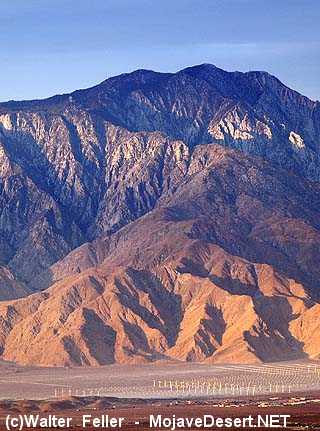
Mt. San Jacinto at dawn