Chronology - Timeline
1604
Juan de Onate is the first European to meet the Mohave Indians while seeking the 'Southern Sea.'1772
1772 The first white men to see the San Bernardino mountain range were deserting Spanish soldiers from the San Diego Mission. They were pursued by Captain Pedro Fages and his troops. Some of the defectors escaped but others were captured. bb Pedro Fages led an expedition along the edge of the western Mojave along the northern foothills of the San Gabriel Mountains looking for deserters from the Spanish Army1776
~ "Spanish Explorers" came through southern NevadaFirst Caucasian crossing of desert: Fr. Francis Garces
1810
May 20 Padre Dumetz named San Bernardino because it was the feast day of St. Bernard of Sienna when he arrived.Padre Francisco Dumetz, a Spanish priest, names San Bernardino (the valley) on May 20, 1810, feast day of St. Bernardine of Siena.[23] Politana, a mission chapel and supply station of the Mission San Gabriel, was the first Spanish settlement in the San Bernardino Valley. wki Sufficient sentiment against the missions had been stirred up that the Mojaves may have been leaders of an attack on Mission San Gabriel. (Mojave Indian history, the Spanish/Mexican period)
1812
The entire area was rocked with repeated earthquakes resulting in an Indian uprising as they believed they were caused by the presence of the Padres.The M6.9–7.5 San Juan Capistrano earthquake affected Alta California with a maximum Mercalli intensity of VII (Very strong) to IX (Violent), killing 40 parishioners at Mission San Juan Capistrano. Serrano attacked and destroyed Politana. wki
1819
Nuez, Fr. Joaquin Pasqual accompanies Moraga into Mojave Desert the Moraga party on a punitive expedition against the Amajaba (Mojave) Indians.1826
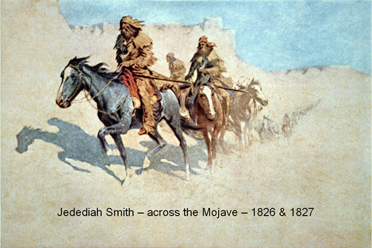
Jedediah Smith explores a route across the Mojave from the Colorado River to San Bernardino1827
The vanguard of a large party of fur trappers and traders led by Ewing Young terrorize Mohave Village. (Mohave enthnography: Explorers)Jedediah Smith returns to Mohave village enroute to Southern California and is attacked by the Mohave. Ten men of his party are killed and two women captured.
1829
San Bernardino Asistencia, a more permanent outpost structure of Mission San Gabriel, constructed.[24] wkiThe Spanish Scout Rafael Riviera becomes first European in the Las Vegas Valley
Antonio Armijo arrives after his scout Rafael Riviera
Ewing Young, Kit Carson, and their 16 companions who reached a Mojave rancheria in 1829 half-dead from thirst, hunger, and fatigue and are helped by Mojaves.
San Bernardino Asistencia, a more permanent outpost structure of Mission San Gabriel, constructed.[24] wki
1830
January 28, the expedition of Antonio Armijo descended to the San Bernardino Valley, from the head of the Mojave River to the mouth of Cajon Canyon to establish the first route of the Old Spanish Trail trade between Nuevo Mexico and Alta California[25] wkiAntonio Armijo and 60 men leave from Abiquiú, New Mexico, for California and arrive there after 86 days. They took trade blankets and serapes to trade for horses and mules and followed a route arriving at San Gabriel, California in January, 1830.
1831
George Yount and William Wolfskill in 1831 arrived with a half-starved party of 20 men at the Mojave villages and are helped by the Mojaves.-
March 31 -- California official complains of horse thieves from New Mexico.
April 23 -- Antonio Santi-Estevan and 30 men from New Mexico trade wool for livestock in California. The exact route of this trip is unclear.
May 6 -- Franco de Fouri, Bautista Saint-German, Bautista Guerra, Zacarias Ham, Luís Burton, Samuel Shields, Zebedia Branch, and Juan Lober arrive in California. Hafen and Hafen list these individuals as being with Wolkskill and Yount.
1832
Friar Cabot of Mission San Miguel reports that New Mexicans traded wool for horses in California; he also claimed that Mission San Miguel had 108 horses and mules stolen and that at the Rancho of Asunción had reported four colts and a mule stolen.August 13 -- Santiago Martín goes to California from New Mexico with 15 men. Hipolito Espinosa (later a settler of Agua Mansa) is with the party. No documentation found for other caravans during this year.
1833
Juan de Jesus “Chino Pando” Villalpando leads an expedition from New Mexico to California by way of the Animas River Route on the “Camino de Nuevo Mexico” or “Road to New Mexico.” Californio Antonio Avila and five men inspect returning New Mexicans’ herds of sheep, horses and mules bound for New Mexico.-
February 2 -- Felipe Lugo and 12 men try to catch up with New Mexicans who had stolen animals from California. They were traveling on the “Camino de Nuevo Mexico” or the “Road to New Mexico.”
February 26 -- Jesus Uzeta, Perfecto Archuleta, and Tomás Salazar from New Mexico steal 430 animals from California and were reported bound for New Mexico.
October 27 -- José Avieta and 125 men with serapes leave New Mexico for California arriving in Los Angeles on December 24,1833.
1834
Mexican secularization of mission properties and herds in 1834https://mojavedesert.net/victor-valley/02.html
Jacob Leese and nine men leave California with 450 horses and mules, lose all but 27 animals to Indians, and return to California. A few days earlier, a party of 19 traders encountered Indians while returning from California to New Mexico and five were killed. =
January 21 -- José Avieta and 124 men from New Mexico arrive in California and trade 1,654 serapes, 341 blankets, 171 bedspreads, and other items such as wool for horses in California. They refused to pay the alcabala, a tax on trade, manifesting a copy of the Decreto de 1830, which they claimed exempted them from the charge. Some of his men went as far north as San José, where they are thought to have been stealing horses. = 1835-1836
1837
William Pope and Isaac Slover travel to California by way of the North Branch with (two-wheeled) wagons pulled by oxen.-
January 16 -- Party of 30 men led by Jean Baptiste Chalifoux enters California from New Mexico arriving at San Gabriel. Chalifoux steals 1,400 to 1,500 California mules and horses and returns to New Mexico.
April -- José María Chávez and his brother Julian Chávez with family members and several others escape New Mexico by way of Utah to California. They had been singled out for execution for siding with Governor Albino Perez who was slain in the New Mexico Rebellion of 1837. A year later, on
October 17 to February 1838 -- John Wolfskill and 33 people travel from New Mexico to California.
December 2 -- The Sandwich Islands Gazette carries a story on New Mexican caravans in California and reports that they had come there “for a number of years past.” The story deals with how New Mexicans rendezvous in the Tulares and influence Indians to raid California for mules and horses so that they can trade them to New Mexicans.
1838
José Antonio García leaves Abiquiú in 1838 for California. He later returned to New Mexico (see entry for 1842).-
Thirty New Mexicans enter Los Angeles with John Wolfskill expedition.
February 6 -- Caravan of traders from New Mexico is restricted in trading and doing any business south of San Fernando.
March 24 -- José María Chávez and his New Mexicans, known by the Californios as the “Yegueros,” found themselves on the rebel side of a California rebellion at the Battle of San Buenaventura, an old mission site, and were captured by government forces under General José Castro. They were later released. José María returned to New Mexico and continued trading in the Utah country into the 1850s; and, Julian remained in California settling Chávez Ravine in Los Angeles, site of the modern Dodger Stadium (see 1840).
September 22 -- Lorenzo Trujillo, José Antonio García, Hipolito Espinosa, Diego Lobato, Antonio Lobato, Santiago Martínez and Manuelita Renaga (who gives birth to a son, Apolinario, at Resting Springs) leave New Mexico, bound for California. These eight individuals are the first settlers of the San Bernardino area.
-
May 16 -- Various New Mexicans petition Governor Manuel Armijo in Santa Fe for passports to go to California. Passports were granted. Many New Mexicans migrate to California.
July 11 -- One New Mexican trader presents his passport in Santa Barbara, California—possibly this person was from the group of petitioners for passports in Santa Fe.
December 21 -- 75 New Mexicans arrive in California and settle near Rancho de San José. This group was probably the one that petitioned for passports in Santa Fe.
1840
William Wolfskill arrives in southern CaliforniaFebruary 21-- Californios report that New Mexicans had stolen horses from California.
April 4 -- Californios report that New Mexicans leaving Los Angeles had passed through Puerta del Cajón on their way back to New Mexico.
April 4 -- 75 men depart California for New Mexico.
May 15 -- Chaguanosos steal 1,000 animals from San Luis Obispo. The Chaguanosos, including Anglo and French trappers and Utes, were associated with New Mexican traders who stole or enticed other people to steal for them. That month this group stole some 3,000 horses.
1841
Mr. Wolfskill marries Magdalena, daughter of Don Jose Ygnacio Lugo and Dona Rafaela Romero Lugo,in January, 18411841 Rowland-Workman party, including immigrants, travel to California.
-
February -- Joseph Walker arrives in California from New Mexico with a party of 14 men, intending to stay two months and purchase horses.
February 10 -- Californio officials report at least two and possibly more expeditions reaching California from New Mexico.
August 11 -- John Rowland given safe conduct to go to California from New Mexico.
1842
The main colonizing party from Abiquiú New Mexico for Agua Mansa arrives. Many of them settled at Politana, which earlier had been founded by Hipolito Espinosa. Santiago Martínez leads 19 families to California. This group is associated with Francisco Estevan Quintana, who planned to settle in San Bernardino area. These families eventually settled San Luis Obispo.-
José Antonio García returns to California for trade in 1842 (See 1838).
John Rowland returns to New Mexico with 300 “stolen” animals. Rowland is in Santa Fe in July 1842. Official California records indicated that the Rowland party was inspected and had three horses confiscated.
February 10 -- Juan Bandini recovers stolen horses from New Mexican traders.
February 12 -- Francisco Estevan Quintana returns to New Mexico to get his family. He returns with them and settles near San Luis Obispo.
April 16 -- Francisco Estevan Vigil party leaves Los Angeles for New Mexico with 194 New Mexicans and purchases 4,150 animals. After being inspected by Californio officials, they depart Cajon on April 21 with 4,141 animals. Nine were confiscated.
June 3 -- California officials inspect incoming caravan from New Mexico for woolen goods for trade for horses “as has been done on other occasions.”
1843
Miguel Blanco/Michael White Rancho MuscupiabeJames P. Beckwourth from Missouri leaves New Mexico with a caravan of 40 mules to California by way of Utah sometime in 1843. He arrives in California in January 1844. Beckwourth’s exact route is not known. The next year Beckwourth will return from California with 1,800 horses.
October 2: Rancho Los Alamos granted to Francisco Lopez. ~ November 22: Rancho Castac (Lebec-Tejon area) granted to Jose Covarabias [spelling per deed]. ~
January 15 -– John Rowland arrives from New Mexico with a considerable number of New Mexicans. Possibly 10 families from New Mexico arrive in California with this expedition. That same year, Rowland and B. D. Wilson leave California bound for New Mexico; they cross the Grand and Green rivers above their confluence. =
March 6 -- 24 people leave California for New Mexico with 252 animals.
November 30 -- A company of men from California is given permission to leave California and trade in New Mexico.
December -- Tomás Salazar and 170 men arrive in Los Angeles from New Mexico with woolen goods. The group is comprised of 165 men and 10 families from New Mexico. They brought serapes and woolen goods to trade and returned to New Mexico in April 1844 (see 1839 and 1840).
1844
John C. Fremont ArrivesLt. John Fremont and Kit Carson cross the Mojave on similar route
Five families arrive in Agua Mansa from New Mexico.
A New Mexican caravan, possibly Beckwourth’s, arrives in California.
John C. Frémont reports meeting New Mexicans, particularly Andres Fuentes and a small party, along the Mojave River.
Indian massacre at Resting Springs avenged by Kit Carson and Alexander Godey of Fremont's expedition
Luís Robidoux is granted a passport to go to California with traders.
1845
Benjamin Wilson leads a posse of 22 men into the San Bernardino Mountains to search for Indians who had been raiding ranches in . He discovers Big Bear Valley and gives it the name it has today. Up until 1845, Bear Valley was known to the local Serrano Indians as Yahaviat, which means “Pine Place”. - bbOctober 21 --New Mexicans at Agua Mansa prepare to defend against Utes.
1846
dd- San Pasqual, fought Dec. 6-7, 1846 near Capistranohttps://mojavedesert.net/victor-valley/02.html
May 13: Mexican-American War declared by U.S. Congress. ~ July 7: U.S. troops land at Monterey, hoist U.S. flag. ~ December 6: Mexican Gen. Andres Pico (as in Pico Canyon) routs U.S. Gen. Stephen Kearny in Battle of San Pasqual [link]. ~ Miles Goodyear takes pack train of hides from northern Utah south to Old Spanish Trail and then on to California. This likely occurred in late 1846 or early 1847. Goodyear learned about the trail from fellow mountain men/horse thieves such as Bill Williams and Joseph Walker. =
March -- California officials report that 1,000 head of horses have been stolen and taken through Cajon by “los Yutas” in the previous three months. Another report says that Utes travel among New Mexicans. =
July 3 -- Californios report on New Mexicans living in California. =
1847
January 9-10: Col. John C. Fremont and troops camp at Rancho San Francisco. ~January 12: Col. John C. Fremont and troops pass through Fremont's Pass. ~
January 13: Mexican Gen. Andres Pico surrenders to U.S. Col. John C. Fremont in the Capitulation of Cahuenga.~
Kit Carson and Lieutenant George D. Brewerton carry messages about the United States-Mexico War using the Old Spanish Trail during this year and the next year. =
-
November -- Porter Rockwell goes south from Salt Lake City to Old Spanish Trail with directions from Miles Goodyear. Jefferson Hunt is a member. This shows direct influence of mountain men in beginning of Mormon Route.=
December -- Miles and Andrew Goodyear travel same route to California to trade for horses.=
December -- New Mexican caravan of 209-225 men led by Francisco Estevan Vigil arrive in Los Angeles (See 1841 and 1848). Juan Ignacio Martínez, Rowland’s brother-in-law, was on the expedition. (John Hussey indicates that the expedition was comprised of 212 travelers, including 60 boys, and departed from New Mexico with 150 mules carrying blankets and other goods.) They return in April 1848.=
1848
dd- Mormon Battalion guards Cajon Pass from horse thieveshttps://mojavedesert.net/victor-valley/02.html
Salt Spring The earliest recorded gold discovery in San Bernardino County occurred at Salt Springs, at a point on the Santa Fe-Salt Lake Trail (Old Spanish Trail). Persistent rumors have it that gold ... !! January 24: James Marshall discovers gold at Sutter's Mill. ~
February 2: Treaty of Guadalupe Hidalgo ends Mexican-American War; California, Arizona, New Mexico and Texas become U.S. possessions. ~
Pratt Party loses way
Hunt and other Mormons return to Utah from California on Old Spanish Trail in an attempt to supply Salt Lake City.=
-
March -- Members of the Mormon battalion are led by Rockwell from California to Utah.=
April -- Miles Goodyear leaves California with horses. Note: Goodyear was inspected at Cajon Pass on April 23, 1848. He had 231 animals and four men. Probably meeting illegal traders beyond the Cajon inspection point, Goodyear acquired and drove an estimated 4,000 animals over the Old Spanish Trail to Utah. Eventually, Goodyear drove his horses all the way to Missouri—over Old Santa Fe Trail—but found that the end of the Mexican War had released many horses onto the market, increasing the supply and depressing prices. In addition, the war and increased Indian hostilities held down immigration and demand for stock during 1847 and 1848. In 1849, Goodyear drives the herd of horses to Sutter’s Mill in California for trade to Gold Rush forty-niners. The Goodyear situation demonstrates the decline of the Old Spanish Trail trade. = (= OLSP-Nps)
April -- The Frenchman named Le Tard leaves Cajon with 231 horses, going [east]ward to New Mexico.=
April -- Francisco Estevan Vigil leaves California for New Mexico with 4,628 animals (see 1847).=
July 4 -- Choteau leaves California and arrives in Santa Fe on August 15. Pratt uses Choteau Route in reverse to get to California.=
1849
March: Bennett-Arcan party leaves Wisconsin in search of gold. ~June 27: Edward F. Beale weds Mary Edwards, daughter of U.S. Rep. Samuel Edwards (Penn.). ~
October 7: Jayhawker party encounters Bennett-Arcan party. ~
November 4: William Manly and John Rogers set out from Death Valley to find help for the stranded Bennett-Arcan party. ~
1849 A portion of the Hunt Wagon party, while looking for a shortcut to the gold fields, becomes the first Caucasians (Lost 49'ers) to cross Death Valley
John G. Nichols leaves U.S. over a “northern route,” gets to Salt Lake City, travels down Mormon Road, picks up the “Santa Fe Road” to the Mojave, and gets to San Bernardino-Agua Mansa area and on to Los Angeles.
1850
First report of gold in these mountains mentioned by Benjamin Hayes in “Pioneer Notes” when two groups of men left the San Bernardino Valley to check the prospects on January 30. (Probably in the Arrastre Creek area, just east of Big Bear Lake.)January 1: William Manley and John Rogers arrive at the Del Valles' estancia, find help for the Bennett-Arcan party. ~
January 28: Forty-niner William Robinson dies in Soledad Canyon from drinking too much cool water. ~
February 4: Bennett-Arcan party & Jayhawkers (Death Valley '49ers) saved when they reach Del Valle ranch headquarters.~
September 9: California admitted to the Union as the thirty-first state. ~
Sitgreaves Expedition
Salt Lake Road established as route across desert to California
Mormon Hogback developed by Banning & Sanford
-
California becomes a state.
The Los Angeles Plaza Church death records contain up to 1850 scattered reference to Paiutes, Utes, or Indians from New Mexico:
1851
1851 The Mormon settlement of San Bernardino began on June 11th when Captain David Seely led the first 50 of 140 wagons and 437 people to a camp at Sycamore Grove. bbOn September 22nd the Mormons bought the 35,000 acre Rancho de San Bernardino from the Don Antonio Maria Lugo family for $77,500. bb
~ May 19: Road from Mission San Fernando to Elizabeth Lake (San Fernando, San Francisquito, Elizabeth Lake roads) declared a public highway.
~ June 8: Prohibitionist Henry Clay Needham born in Percival Mills, Hardin County, Kentucky.
~ August 2: Los Angeles County divided into six townships [source: Thompson & West].
~ December 14: SCV landowner Ygnacio del Valle marries Ysabel del Varela at Church of Our Lady of the Angels, Los Angeles.
1852
Mormon Lumber Road is built up West Twin Creek to the top of the mountain near today’s Crestline.bb- First steam sawmill was then set up by Charles Crismon in Twin Creek Canyon using the boiler and engine from the Salt Spring Gold Mine which was abandoned because of Indian attacks.
1855
First gold reported found at Big Bear Valley, but water was scarce to mine it.1858
bb- First filing of a mining claim in these mountains was by John Cook. He claimed “160 acres 9 or 10 miles from Bear Lake” (present Baldwin Lake). Included in the claim was the “Bear Lake Silver Mine 1 1/4 miles from a spring at the head of a canyon leading to the desert.”1859
vr- By late 1859 the Mojave Road was established as a viable wagon road between Los Angeles and the Colorado River.bb- First recorded mining in Big Bear Valley at Starvation Flat.
~ Edward F. Beale appointed superintendent of Indian Affairs, later surveyor-general of California and Nevada.
1853
~ San Sebastian Indian Reservation established at Tejon.~ March 3: Congress authorizes Secretary of War to chart a route for transcontinental railroad, appropriates $150,000.
~ March 3: President Millard Fillmore appoints E.F. Beale Superintendent of Indian Affairs for California and Nevada.
~ May 6: Party of 14, including E.F. Beale, departs from Washington, D.C., to chart a route for transcontinental railroad.
~ Lieutenant R.S. Williamson surveys Santa Clarita Valley during expedition to chart route for transcontinental railroad.
~ August 22: E.F. Beale reaches Los Angeles on mapping expedition.
~ December 30: Boundary established between United States and Mexico [link]. 1853 Lt. Robert Williamson explores the Mojave River while looking for a route to the Colorado River
dd- 1853, the year San Bernardino's settlers petitioned to create a separate county
1854
~ May 31: Congress appropriates another $40,000 for exploration of a route for transcontinental railroad.~ July: Gold discovered on the Kern River.
~ August 5: Congress appropriates another $150,000 to complete exploration and reports on route for transcontinental railroad.
~ August 10: Fort Tejon established atop Grapevine Pass.
~ December 5: Gen. Phineas Banning drives first stagecoach through thirty-foot-deep cut at Fremont's Pass.
Whipple Expedition
1855
bb First gold reported found at Big Bear Valley, but water was scarce to mine it. bb% United States surveyors first visited and recorded Oasis of Mara area in 1855 and 1856.
~ June 3: Supply (a ship) leaves New York harbor bound for Tunis to acquire animals for the United States Camel Corps.
~ July 11: Severe earthquake felt in Los Angeles County.
~ August 8: Surveyor-General Edward F. Beale acquires Rancho La Liebre, then Castaic, Los Alamos, Agua Caliente and El Tejon.
^ Mormons arrive in Las Vegas and establish fort
^ First Post Office established and is named Bringhurst after Mission President William Bringhurst
1856
~ January 9: Severe earthquake felt in Los Angeles County; 2 killed.~ May 13: Colonel David D. Porter arrives in Texas with camels bound for Fort Tejon.
1857
Sanford develops pass further west from Hogback~ January 9, 8:13 a.m.: Major earthquake decimates Fort Tejon.
^ Mormons abandon Mormon Fort
Beale Expedition
= Mountain Meadows Massacre, 120 emigrants, including women and children, meet thier death along the Old Spanish Trail in southwestern Utah.
wiki – Brigham Young recalls Mormons to Utah. San Bernardino disincorporated.[31] The first orange trees are brought to the valley.[32] The Fort Tejon earthquake ruptured the San Andreas Fault, the last major earthquake on the San Bernardino portion of the fault to this day.[33]
1858
bb First filing of a mining claim in these mountains was by John Cook. He claimed “160 acres 9 or 10 miles from Bear Lake” (present Baldwin Lake). Included in the claim was the “Bear Lake Silver Mine 1 1/4 miles from a spring at the head of a canyon leading to the desert.” ~ January 27: Then-Colonel Edward F. Beale drives camels through Los Angeles.~ July 31: L.A. Star reports progress on cut through Newhall Pass, but government funding is insufficient.
~ October 7: Butterfield Overland Stage rides into Los Angeles.
~ October 8: Butterfield Overland Stage rides through Fremont's Pass and San Francisquito Canyon.
- Aaron Lane
He had barely settled in before his ranch was raided by Indians. Other attacks followed throughout the years, and once he was even forced to ...
Rose-Bailey Wagon Train
1859
bb First recorded mining in Big Bear Valleybb Bill Holcomb arrives at Big Bear Valley in the late fall.
Samual Bishop drives supplies east on Mojave Road
Bodie, California - ... by prospector Wakeman S. Bodey, who the town was named after. Bodey died in November making a supply trip and becoming stranded in a blizzard. !!
~ June 25: Outlaw Tiburcio Vasquez escapes from prison while serving sentence for grand larceny in L.A. County; recaptured in August and sent to San Quentin.
~ August 16: Outlaw Tiburcio Vasquez returns to San Quentin to serve one-year sentence for grand larceny in Amador County.
Hoffman Establishes Ft. Mojave wiki – San Bernardino County votes to secede from California to form the Territory of Colorado, voting 421–29 in favor of secession.[34]
1860
bb In late April, Bill Holcomb and Ben Choteau went to Holcomb Valley prospecting. Testing a sample, they found paying gold in Carribu Creek. On May 5th the group located the first mining claims in Holcomb Valley, and started Southern California’s largest gold rush.bb The first 4th of July in the new mining camp was celebrated with the help of blacksmith Jed Van Dusen’s wife, who fashioned an American flag from a miner’s shirt and a dance hall girl’s skirt.
The town of Belleville was named after her daughter, Belle, by the grateful miners. The population was soon over 1000, and in the November election Belleville missed becoming the county seat by only two votes. Coso - Coso was discovered in March 1860 by Dr. E. Darwin French who was looking for ...
Tecopa at approximately the same time Pablo Flores discovered Cerro Gordo, silver-lead ores were discovered ...
~ April 7: Los Angeles Star (newspaper) reports string of Army wagons from Fort Tejon traversing Newhall Pass.
1860-70 Mining strikes in and near the desert; grazing starts in the eastern Mojave to support miners
1861
dd- Techatticup mine, located Begin Civil Wardd- St. George, Utah founded. bb- First road into Holcomb Valley completed by Jed Van Dusen using $1500 contributed by the miners. It connected with John Brown’s new Cajon Pass Toll Road near present Hesperia.
bb- The heaviest winter ever recorded in California began on Christmas eve. It rained and snowed for 28 days, and on February 6th the snow was “sixteen feet deep at the mountain sawmills.”
!! White Mountain City - A year after the discoveries at Coso, J. S. Broder, Col. L. F. Cralley, the Graves brothers and Dan Wyman ...
!! New York Mountains - James Crossman indicates that mining commenced in the New York Mountains in 1861 ...
!! Sage Land Mining District - Shortly after the town of Claraville was founded in 1861 prospectors discovered ...
~ May 7: Andres Pico and partners granted state franchise to build toll road and cut 50-foot-deep cleft through (Newhall) Pass; they failed; Beale later succeeded.
~ June 7: Army officer in San Francisco informs Fort Tejon's commanding officer that the fort, est. 1854, is to close and its garrison transfered to Los Angeles.
~ June 28: Incorporation of Central Pacific Railroad.
~ U.S. Army Camel Corps discontinued.
Remi Nadeau arrives in Los Angeles from New England with one team of oxen
Fort Mojave was abandoned in May 1861
1862
!! The Rise & Fall of Cerro GordoOriginally a small-scale operation worked by Mexicans between 1862 and 1866, the mine was included ...
!! Turtle Mountains-Sunrise District Perhaps as early as 1862, rich gold and copper deposits were being worked in the Turtle Mountains.
!! Whipple Mountains Within the Whipple Mountains area, the Chemehuevi District extended from opposite the Bill Williams River to ...
!! Copper Basin Mining in Copper Basin is what sparked interest in the Whipple Mountains during this century. ...
~ January 18: Torrential rainfall washes out cement-walled road through Newhall Pass (future Beale's Cut).
~ Three-year drought begins, ruining cattle industry.
~ General Andres Pico improves road through (Newhall) Pass.
Floods in Mojave Desert
Indians and secessionists were not the only troubles besetting the area; the largest storm of record in ...
Brown's toll road/Van Dusen road
1863
!! Freeman District In October, 1863, it was described as “quite a large one (district) containing many ...!! Irataba District (Marengo) The Irataba Mining District, heralded as the “richest copper district on the Colorado,” was ...
!! Rock Spring Charles Hamilton and Francis B. Austin on March 12, 1863, discovered some rich silver ore about
~ April 26: Explosion of Phineas Banning's boat in San Pedro harbor, killing Banning's brother-in-law W.T.B. Sanford, who had helped dig first cut through Newhall Pass in 1850s.
~ August 30: State Sen. James Russell Vineyard, one of trio (w/ A. Pico) hired to cut road through (Newhall) pass, dies in Los Angeles without doing it.
~ September 19: Gen. Edward F. Beale loans $2,000 to A.A. Hudson and Oliver P. Robbins to erect toll house in Newhall Pass.
~ December 23: Beale having completed his initial construction contract, Board of Superivsors orders him to keep cutting down the Newhall Pass road to a 20 percent grade.
1864
!! El Paso Mining District (Date approximate) A Manzanillo Mine was being operated in 1864 and 1865 by the ...& Borax first produced commercially in the United States in California at Clear Lake north of San Francisco. 1864 to 1868
~ Private James Gorman establishes community of Gorman.
~ March 5: Los Angeles Star reports that the Board of Supervisors has accepted Gen. Beale's cut through Newhall Pass as finished.
~September 11: Fort Tejon abandoned.
^ 1864 - Nevada is admitted to the Union by President Lincoln
1865
^ 1865 - Octavius Decatur Gass takes over old Mormon Fort and Establishes Las Vegas Rancho1866
!! Anthony Mill Ruins - There is an almost certainly spurious story circulating that this mine was worked by Mormons. ...1866-68
Mojave Road used as mail route; military outposts established along the route
1867
~ January 18: Tiburcio Vasquez begins serving 4-year prison sentence for grand larceny in Sonoma County.bb- Last Indian battle in Southern California ended at Chimney Rock above Rabbit Lake in February, after 32 days of fighting.
1868
!! Clark Mountain - Ivanpah a Piute Indian brought a piece of metallic copper to Johnny Moss, “a frontiersman and well-known prospector.” After ...% Belshaw obtained a one-third interest in the Union Mine on May 6, 1868
# Sageland, which by the spring of 1868 had a saloon and a billiard room, hotel, miner's store, sawmill; two stage lines to Havilah, and an opera house
1869
Max Strobel purchases Hesperia township1870
Darwin (Also see 1874)... gold, silver, and lead deposits were again discovered in the Coso Range, resulting in ...Avawatz
Avawatz, also spelled Ava Watts, Ivawatz, Iva Watch, and Ivanatz is probably derived from the Mohave word Avi-Ahwat meaning ...
1871
Hesperia township to German colony, 35th Parallel associationChloride Cliff ... some say he picked up a rock to kill a rattlesnake and found ore--Franklin somehow found what he thought was a vein of ...
George Englemann of the USGS's 40th parallel exploration team studies the desert and gives scientific name to the Joshua tree
1872
35th Parallel Assoc. Oro Grande-Silver Mountain On April 25, 1872, the McKinzie Mining District was organized, encompassing everything from about ...1873
Old Woman Mountains - About March of 1873, Mr. S. C. Hammer discovered a ledge “situated between the Old Woman Mountain and the Colorado,” while ...Twentynine Palms
The first discoveries in the Twentynine Palms area were made by Dave Gowen and Joseph Voshay. ...
Panamint
Another product of the search for the Lost Gunsight Mine was Panamint, a boom camp whose mines were first discovered by bandits ...
Remi Nadeau operates 80 freight teams hauling silver bullion from the mines at Cerro Gordo to Los Angeles
1874
wiki - The first permanent court house[35] is founded on Court Street near "E" Street. bb- Fighting five feet of snow, Sam Baird and four carpenters started construction of a house and blacksmith shop at the Gold Mountain Mine.Spring found Judge Wagner surveying a town site on the flat below the mine.
Over time it would have four names: Bear Valley, Gold Mountain City, Bairdstown, and Doble.
Panamint City begins shipping silver
Southern Pacific - San Francisco - LA. 1874-1876
Tehachapi Loop
Large borax deposits located in Saline Valley. Minor production began at Searles Lake in San Bernardino County.
Darwin
The silver-lead ore bodies at Darwin (named after Dr. E. Darwin French) were discovered in late October or ...
1875
Savahia Peak AreaWest of Copper Basin, probably one of the first mines to be developed was the American Eagle. A somewhat confusing account in ...
Exchequer District
In the 1870s an old German named Erick Vontrigger made some mineral locations, and camped at what is known as Vontrigger Spring, ...
Waterman
(Date approximate) Five years before the famous silver discoveries at Calico, George G. Lee discovered what he thought was ...
Riggs Mine
In 1875 he married Sarah and soon after made the first discovery in the Silurian Hills at the Alta Mine. ...
1876
Ord Mountains-Fry MountainsSandie Lochery located the first mining claims in the Ord Mountains in 1876, naming them the Ord Group. ...
Lookout
Two years after the discovery of Panamint, on April 22, 1875, rich silver-lead deposits were discovered on ...
1877
Wildrose Charcoal KilnsThe kilns operated until the summer of 1878 when the Argus mines, due to deteriorating ore quality, closed and ...
Beveridge
Probably the most inaccessible gold-producing district in Inyo County, and also its most productive, ...
1879
Dry Lake & VicinityIn the fall of 1879, George G. Lee, the man who generally is credited with the discovery of silver at Calico, died ...
1880
Providence & The Bonanza KingAndy McFarlane and Charley Hassen “concluded to try their luck, and were rewarded by the discovery of a wonderful bonanza.”
Providence
... prospectors from Ivanpah, discovered rock that assayed from $640 to $5,000 a ton in silver. Their discovery, about 15 miles ...
Nantan
The Cambria was a gold and silver mine discovered sometime before the spring of 1880 by ...
1880
1880s - Land in Upper Grapevine Canyon, on which Scotty's Castle would be built, was originally patented by Jacob Steininger during the 1880s under the provisions of the Desert Land Act of 1871^ Archibald and Helen Stewart acquire Las Vegas Rancho from Octavius Decatur Gass for $5000.00
California Southern RR incorporated ~s
(614 Bancroft)
The California Southern railroad was chartered Oc tober 12, 1880, to construct a line from San Diego to San Bernardino, and the California Southern Exten sion company was chartered May 23, 1881, to extend this road to a connection with the Atlantic and Pa cific in California, at a point about eighty miles north east of San Bernardino. The two companies consoli dated under the name of the first above mentioned, and the road was completed to Colton in August 1882, and opened from San Diego to San Bernardino September 13, 1883.
Soon afterward the Southern Pacific, obtaining through the purchase of stock a share in the man agement, secured the extension of the Atlantic and Pacific to the Colorado at the Needles, which com pelled it to connect there with the former. This had nearly been a death-blow to the California Southern, which had suffered much, not only by opposition, but by floods in the Temecula canon, which rendered im- /
passable thirty miles of its track, carrying bridges and ties entirely away, some being seen a hundred miles at sea. It must not only rebuild this thirty miles, but in order to reach the Atlantic and Pacific, must construct 300 miles of new road over mountain and desert, instead of the 80 miles as first intended. For several months the directors hesitated. But finallv the Southern Pacific determined to sell to the t/
California Southern the road from the Needles to Mojave, built by the Pacific Improvement company, 22 the successor of the Western Development company. The transfer took place in October 1884, and the California Southern at once recommenced construction and repairs, and in November 1885 opened its line
from San Diego to Barstow. In October 1886, it formally passed under the control of the Atchison, Topeka, and Santa Fe company, and was operated as a division of that road. Thus after ten years of strug gle, two of the eastern roads effected an entrance into California. 23
1881
Harmony Borax WorksDuring the summer months, when the weather was so hot that processing water would not cool enough to permit ...
Calico Ghost Town
Below the Silver King Mine the town of Calico grew slowly. In the spring of 1882 there were only 100 people living ...
Alvord Mine
The Alvord Consolidated Quartz Mining Company, in February, 1881, agreed to ...
Southern Pacific - Mojave - Calico Station (Daggett)
& Borax discovered in Death Valley by Aaron Winters.
1882
Chaffey Brothers HesperiaProvidence Mountains (Gold-Iron)
The gold mines in the Providence Mountains that were first worked lay south of Foshay Pass, and were discovered as early as
Southern Pacific
^ Helen Stewart gives birth to Evaline La Vega Stewart named after Las Vegas
Southern Pacific builds to Needles - 1882-83
& Harmony Borax Works begin production. New form of borax ore discovered on the south side of Furnace Creek Wash in the area of Monte Blanco and Corkscrew Canyon in Death Valley.
1883
Coleman buys Monte Blanco claim south of Furnace Creek wash in the Black Mountains.California Southern Railroad completed to San Bernardino -conflict with crossing ~s
Atlantic & Pacific builds to Kingman
Carson & Colorado - Keeler
1884
Big Beaar dam completeWilliam B. Strong saves fledgling CSRR
Kramer
In July 1884, the Kramer Siding on the Santa Fe Railroad had but one inhabitant, the depot agent. However, ...
^ Archibald Stewart murdered at Kiel Ranch - First Las Vegas Murder - Unresolved
Atlantic & Pacific crosses Colorado River
Atlantic & Pacific leases then buys line from Waterman Junction (Barstow) to Needles from Southern Pacific and connects it to A & P line (1885?) (A&P becomes Santa Fe.)
~ May 2: Brothers McCoy and Everette Pyle discover Tataviam Indian artifacts in Bowers Cave.
1885
November 15—Completion of California Southern extension (ingersoll)California Southern Cajon Pass: Barstow - San Bernardino
Hesperia sold to Finck
1886
Proposed California Southern RR route up East Cajon Canyon (Ingersoll)Hesperia sold to McNeil
~ April 27: Legend is born: Article published in San Francisco Chronicle points out connection between Rancho Camulos and H.H. Jackson novel "Ramona."
1887
Widney buys Hesperia1888
Coleman dissolves his financial empire and holding taken over by Francis Marion Smith. Pacific Coast Borax Company (PCB) founded by Francis “Borax” Smith.
Paradise Mine
In 1888, large deposits of gold ore were known to exist at Paradise. The ore was reported to pay ...
1890
Vanderbuilt The gold at Vanderbilt was discovered by Bob Black, A Piute Indian, about 1890. However, he “had the usual experience of ...1892
~ December 20: Benjamin Harrison establishes 555,520-acre San Gabriel Timberland Reserve (Angeles National Forest). First forest reserve in California, second in U.S.1893
C. Hart Merriam conducts a biological study of Death ValleyNevada Southern Railroad: Goffs - Manvel/Barnwell
North Sacremento Mountains
In April, 1893, the new Needles Reduction Works started up on ore from the Ibex. By ...
Ballarat
Charles Anthony and John Lampier located the Panamint Valley Mine on July 27, 1893. This mine, also known as ...
1894
Lost Horse MineWhen the story of the Lost Horse Mine is told, it sounds like a western campfire tale: gun slinging cowboys, cattle rustlers, horse ...
1895
California Eastern RR1897
Stone Hammer MineTwo companies, known as the Himalaya Mining Company and the Toltec Mining Company set to work on the property. The Himalaya Company sank a well and ...
The Orange Blossom Mine
In 1897 a Chemehuevi Indian named Hikorum discovered ore north of Amboy. Hikorum , “a prominent man among his people, ...
1898
Bagdad-Chase MineAbout 1898 John Suter, a roadmaster for the Santa Fe, headed into the hills south of Ludlow looking for water. Instead of water, he discovered
Copper City
Copper City reportedly was first discovered in the 1880s. In 1898, Copper City was alive and the Juanita Mine was ...
Goldstone
(Date approximate) Gold was reportedly discovered at Goldstone as early as the 1880s. During the late summer of 1910, ...
1898 Randsburg Railway
1899
Rosalie A post office was maintained at the Ivanpah camp until April 24, 1899, at which time it was moved to ...1902
Ludlow & Southern Railway III1902 Barnwell & Searchlight III
1903
& Development of the Lila C. mine begins on the western edge of the Amargosa Valley and along the east slope of the Greenwater Range. This was the first Colemanite mine in the region.^ Helen J. Stewart Sells Las Vegas Rancho to Montana Senator William A. Clark for $55000.00
& Development of the Lila C. mine begins on the western edge of the Amargosa Valley and along the east slope of the Greenwater Range. This was the first Colemanite mine in the region.
1904
Tonopah & Tidewater1905
Town of Las Vegas established with the opening of the Salt Lake, San Pedro & Los Angeles Railroad & 1905 to 1907 – Tonopah and Tidewater Railroad built from Ludlow to Death Valley Junction with spur line laid to the Lila C. camp of Ryan station. The town of Borate was abandoned and all its equipment moved to the Lila C mine. In 1914 the Lila C. starts to play out.First Train Arrives in Las Vegas
San Pedro, Los Angeles & Salt Lake
Tonopah & Goldfield
1905-06 Tonopah & Tidewater railroad built from Ludlow to Tonopah via, Death Valley; abandoned during WW II
Pete Aguereberry and Shorty Harris discover what turns out to be the Eureka mine.
1906
Las Vegas & Tonopah1906 Salt Lake City–Los Angeles railroad built through the desert (later became Union Pacific Railroad)
1906 Albert M. Johnson and Walter Scott (Death Valley Scotty) made their first journey to the Death Valley region to inspect Scotty's elusive mines. 1906-1922 Johnson and Scotty visited the Death Valley area about a half dozen times, the former relishing the climate, scenery, and isolation of the region as well as the companionship of the latter.
1907
1907 - First Telephone wires installed in Las Vegas1907 Bullfrog Goldfield
1908
1908 Arizona & California - Cadiz - Rice - Parker1909
1909 - Clark County, Nevada Created1909 - First Theater the Isis opens
1910
1910 - State of Nevada Bans Gambling1910-30 Homesteading in Lanfair Valley
1911
1911 - The City of Las Vegas is incorporated.1912
1912 - The Majestic Theater Opens1912 SP Jawbone
1913
1913 Trona Railway1914
& Jan. 26, 1914 – Death Valley Railroad Company founded to build a new rail line from the Lila C. branch 3.19 miles out of Death Valley Junction at Horton to the Biddy McCarthy mine. (1)& Dec. 1, 1914 – Seventeen mile railroad completed to Biddy McCarthy mine at a cost of $370,000. In the interim the Lila C mine had been shut down and all the old buildings in Ryan were loaded on rail cars and hauled to their new resting place on the slope adjacent to the Biddy. (1)The company first named the camp Devar, for the Death Valley Railroad. But it was renamed Ryan in honor of John Ryan. (1)
~ First Movie Filmed - The Hazards of Helen
1915
1915-1917 - Johnson began acquiring old homesteads and mining claims in northern Death Valley, including the Steininger Ranch property which he dubbed the "Death Valley Ranch." His holdings, which eventually totaled more than 1,500 acres, were split into two separate parcels about eight miles apart - the Upper and Lower Grapevine ranches. CONSTRUCTION PERIOD& January 1915 – The Lila C. mine was closed but not completely abandoned. Activity shifts to new town of Devair. A new calcining plant is built at Death Valley Junction.
& 1915 – Prosperous large-scale metal mining in Death Valley ended around 1915. Other claims near the Biddy were put into production within a year or two. The Played Out opened first. Work then started on the Grand View and the Lizzie V. Oakley. A winding 2-foot gauge rail line, the Baby Gauge, was laid to those mines. (1)
1915-1916 California Southern (II) Rice - Ripley
1916
& 1916 – John Ryan of Pacific Coast Borax retires. (1)1916 Federal Aid Road Act leads to development of Route 66 parallel to the railroad
1918
Jaeger visits Hesperia1920s
1920s Los Angeles' population doubles; one automobile for every three citizensLas Vegas' population grows and gambling takes off during prohibition
1920 - ?? First Airplane Lands in Las Vegas - Randall Henderson and his Jenny
1921
Johnson decided to make improvements and construct more civilized accommodations on the Death Valley Ranch.1922
Johnson began developing plans for the ranch and hired Frederick William Kropf as construction superintendent to oversee the improvements.1922-1924 Kropf supervised all facets of construction of the first three structures - a garage, two-story main house, and cook house - before being dismissed in July 1924.
1923
?? First Rodeo Las Vegas1924
1924-1925 Construction of three secondary structures - the stables, chicken coop, and workshop/shed - was commenced using plans developed by Johnson.1925
Matt Roy Thompson was hired as general superintendent for construction in October.1925-1926 Under the direction of Thompson the three secondary structures were completed, and a onestory building, originally known as the "Cellar" but later referred to as the "Commissary," was erected parallel and to the north of the main building.
1926
?? First commercial airline flight, Western Air Express1927
?? First Golf Course built1929
Dewey R. Kruckeberg was hired as a landscape architect to supervise and direct the landscape design of the ranch.?? Las Vegas High School opens
1930s
1930s Great Depression drives many from cities to the desert for gold and for land to raise cropsLas Vegas booms again with return of alcohol; jobs from building Hoover Dam
?? Hoover Dam construction begins in Black Canyon
?? Gambling legalized in Nevada
?? First Gaming License Issued to Las Vegas resident Mayme Stocker
1933
?? Historic Downtown US Post-Office and Federal Courthouse opens1935
- ?? Hoover Dam dedicated by President Franklin Roosevelt1934
?? First Helldorado Days Parade Held1938 Route 66 fully paved
WWII Gen. Patton trains tank troops throughout Mojave Desert. Policy to eliminate coyotes and other destructive behaviors modify large sections of desert flora and fauna
1900-1989 Timeline in part from Las Vegas News Bureau