Kern County: El Paso Mountains
MISCELLANEOUS EL PASO DISTRICT MINES
In 1939, a pumice deposit, now known as the Calsilco, was first worked northwest of Bonanza Gulch. The Insulpum Corporation worked this deposit in 1945. A year later the Calsilco Corporation took over operations. The pumice is worth approximately $50 to $80 a ton for use in a variety of products ranging from paint fillers and oil absorbers to toothpaste.16
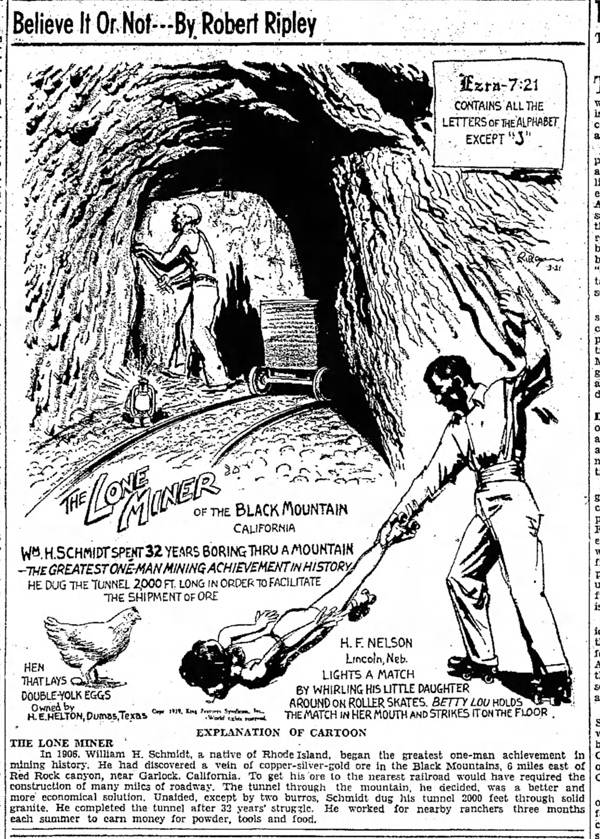
The Copper Basin group was composed of 26 claims formerly owned by William “Burro” Schmidt who had single-handedly dug a tunnel 1,872 feet long to provide better access to his mines. By 1938, when he had completed his access tunnel, his copper mines were largely undeveloped. He was so interested in finishing his tunnel that the mines had completely escaped his attention. This engineering feat, located 9 miles northeast of Cantil, earned Schmidt recognition in Ripley's “Believe it or Not” newspaper series. The Apache Copper Mine and Holland Camp were developed in the late l930s. A mill at the camp in 1940 recovered a few ounces of gold and less than 100 pounds of copper. The mill was located 14 miles northeast of Cantil. The Zuna Copper Mine, located on the south side of Last Chance Canyon, yielded 30 tons of copper bearing quartz in 1941.17