The Whole Mojave
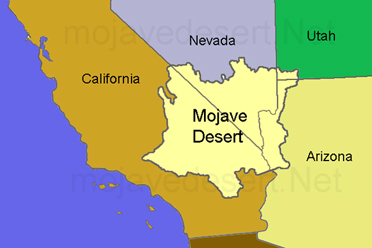
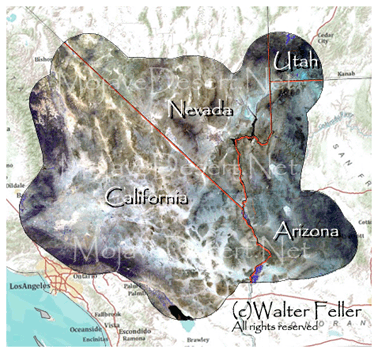
The Mojave Desert occupies a significant portion of Southern California and
parts of Utah, Nevada, and Arizona. Named after the
Mojave Native Americans it occupies
roughly 54,000 square miles in a typical Basin and Range topography.
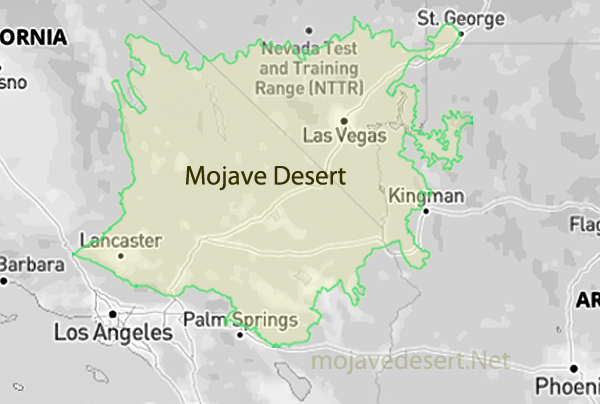
The Mojave Desert is bound in part on the western end by the
Tehachapi
together with the
San Gabriel and
San Bernardino
mountain ranges. The mountain boundaries are quite distinct since they have been created by the two largest faults in
California: the
San Andreas and the
Garlock. Its northern and eastern boundaries are
less distinct. One way to determine location is by observing the presence of
Joshua Trees.
The Mojave Desert receives less than 6 inches of rain a year and is generally between
3,000 and 6,000 feet in elevation. The Mojave Desert also contains the
Mojave National Preserve,
Joshua Tree National Park
and the lowest-hottest place in North America:
Death Valley,
where the temperature can approach 120F in late July and early August.
The Mojave, like all deserts in general, is known for its summer heat, however,
there is wintertime cold.
Snow, although uncommon, does fall in parts of the Mojave.
Amounts range from just a trace to a foot or more of heavy wet snow which can lead to
freeway traffic closures and being "snowed in". The coldest wintertime temperature
ranges below freezing yet above 0F. Many parts of the Mojave
typically range from highs of around 95-105F in the summer to lows of around 20-30F
in the winter.
High winds, often above 50 miles per hour, are also a weather factor and occur frequently
along the
western end of the Mojave,
and are less common toward the
east.
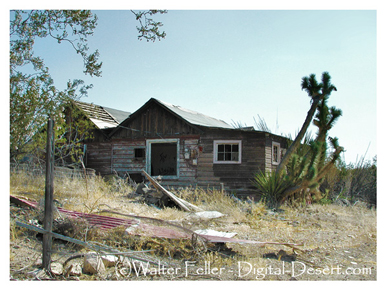
The Mojave Desert contains a number of
ghost towns. The most well known of
these being the silver-mining town of
Calico,
California. Some of them are of the more modern variety created when
Route 66
was abandoned in favor of the
Interstates.
Among the more popular and unique tourist attractions in the Mojave is the self-described
World's Largest Thermometer at 134 feet high, reportedly also the highest temperature ever
recorded in the region located along
Interstate 15 in
Baker,
California.
Mojave Desert - An Overview
Adapted from BLM, Shaping the Classic American Desert
Introduction
Overview
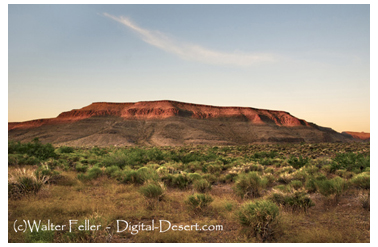
Click for a closer look ...
 Mojave Desert A-Z
A geographic tour of the Mojave Desert