Return to San Gabriel
During my absence one of my Indian guides who had been imprisoned was released by death and the other was kept in the guard house at night and at hard labor during the day having the menial service of the guard house to perform. I took a convenient opportunity to speak to the Father in his behalf he told me he would do all in his power for his release. From his expression I took the idea that government had ordered their imprisonment. the fathers had given me some Iron and my Smith had made in the shop of the Mission as many horse shoes as I wanted. He had also given me some saddles and the leather for rigging them. It was on the 10th of January 1827 that I returned from St Diego. The next day I went down to the Courier got my supplies and returned to the Pueblo Los Angelos and put up with my friend F Abella commenced buying horses and in a short time had as many as I wanted. When I left the Courier I took leave of my friend Capt Cunningham. Should chance ever throw this in his way he will perhaps be gratified to find that I have not forgotten his name or his friendship. That I recollect with the most grateful feelings his kind offices in times that made them doubly valuable and in a country to which he had traveled by the unmarked and perilous paths of the Ocean while my way had been through an unknown Land over mountains and parched inhospitable plains. Meeting in a distant country by routes so different gave an instance of that restless enterprise that has lead and is now leading our countrymen to all parts of the world that has made them travellers on every ocean until it can now be said there is not a breeze of heaven but spreads an american flag.
In this place I will give some Ideas in relation to this
country of a general nature which may perhaps be interesting. California as I
have before observed was settled by Missionaries of the order of St Francis
about sixty years since. They established missions in various parts of the
country and in civilizing the indians and in imparting to them the benefits of
religion they found the opportunity to establish over them the most absolute
power. The number of indians under the control of each mission varies from 300
to 2000, which are under the care and direction of a priest who is stiled the
father and who sometimes has a subordinate or two. The indian has no individual
right of Property although he is told that he has an interest in his labors and
in the proceeds of the farms and herds of the Mission. He has not the right or
at least the power to marry without the consent of the father. for the sexes
are not allowed to Labor together during the day and at night they are shut up
in separate apartments. And although since the revolution they are by express
provision declared free and the fathers were ordered to inform them of the fact
yet it does not appear that it has made any material change in their situation.
It is not uncharitable perhaps to suppose that the fathers in making known to
them their right to freedom have done it in such a way that it appeared to them
from their ignorance a change not to be desired. They said to them - I am told
-You live in a good country you have plenty to eat to drink and to wear your
father takes care of you and will pray for you and show you the way to heaven.
On the other hand if you go away from the Missions where will you find so good
a country who will give you cloths or where will you find a father to feed you
to take care of you and to pray for you. Such arguments as these coming from a
source long respected and venerated and acting on the minds of ignorant and
superstitious beings has had the effect to keep the Indians in their real
slavery without the desire of freedom. whatever the causes may be the fact is
certain that very few have availed themselves of the privilege of the revolution.
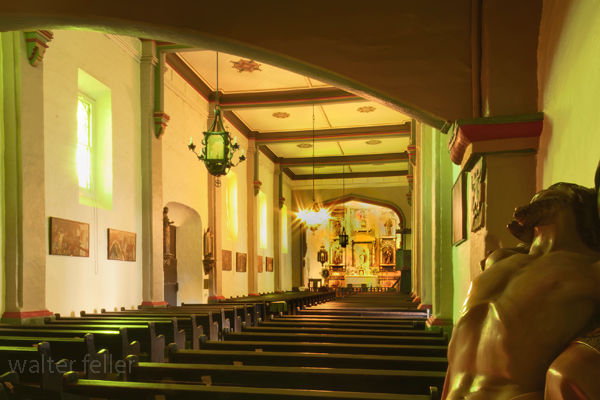
San Gabriel Chapel
The Missions setting aside their religious professions are in fact Large
farming and grazing establishment conducted at the will of the father who is in
a certain degree responsible to the President of his order residing in the
Province. The immediate supervision of the different kinds of business is
confided to Overseers who are generally half Breeds raised in a manner somewhat
better than the common mass under the eye of the father from whom they
sometimes receive a limited education and to whom in some instances they might
with strict propriety apply the name of father -The Indians are employed in the
different kinds of work attendant upon farming and herding of stock the
manufacturing of blankets of coarse wool which form their principle clothing the
making of soap, brick and in distilling. Their labor does not appear to be
unreasonably hard. They are required to attend church regularly every morning
after which they immediately move off under the direction of their respective
overseers to the business of the day.