On the Frontier:
Salt Grass
A long day's march, during which no drinking place for man or beast is passed, brings us to the Mojave river, down to an altitude of only three thousand feet, and by a short sharp descent of the sandy rim of the river's " bottoms," to our camp ground -.- a flat meadow of "salt grass." This salt grass is short, tough, and wiry ; will cut like a knife the hand that incautiously pulls it; and is covered with an incrustation of fine salt. In some places so thick is this efflorescence, as to give the ground the appearance of being covered with white frost ; and everywhere the grass is quite salt to the taste. Horses and cattle will eat salt grass, when they can get nothing else ; but it is not good food, being very weakening, and making them thirsty, in a land where the water is always more or less poisonous. A hundred yards in front of our camp is a long, almost still pool of clear but greenish water, around which grow beds of rushes and thickets of willows. At its upper end this pool is fed by a stream, which is the head-water of the Mojave river ; and from the salt-grass meadow whereon our camp has been just pitched, it receives the trickling flow from several springs of alkaline water. At its lower end this lagoon becomes a sharply running narrow stream -.- the river. The water runs merrily along for a few hundred yards, and then sinks in the thirsty soil, not- to appear again for many a long mile. A solitary white stork, a few blue cranes, serve to give point and emphasis to the lonely dreariness of the scene. A succession of very similar camps, at places where the river rises to the surface in pools and short reaches of water, and then sinks -- at an average distance of twenty miles apart -- and we find ourselves at "The Caves," distant from the Cajon Pass a hundred and ten miles, and nearly fifteen hundred feet above the sea-level.< Previous - Next >
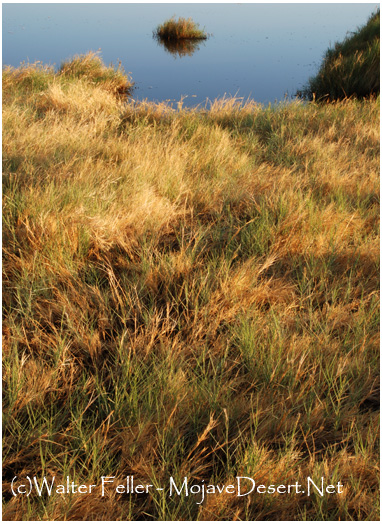
Salt grass