Material Culture, Technology
The Serranos acquired the many species of large and small animals available in the area with throwing sticks, various types of traps, nets and snares, arrows, and sinew-backed bows. They also used poison. Baskets were the containers of choice for gathering plant products. These were used not only for transporting the plant products, but also for winnowing, cooking, and storing. Cooking in baskets was carried out by placing hot stones in food held in tightly woven baskets. While the adults and older children were carrying out their various tasks, babies lay or sat in baskets, sometimes carried by the mother, sometimes placed on the ground or a convenient rock. Although one might assume that pottery would have less use than basketry in a desert environment, a considerable number of pottery vessels have been found in the area, showing that pots were used for carrying and storage. Pottery vessels were useful for carrying water, the slight evaporation keeping the remaining water cool. Pottery was often used to cache precious or sacred property in caves when necessary.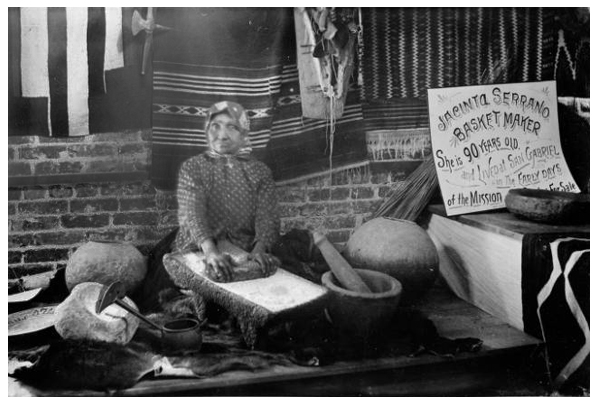
Serrano basketmaker - C.C. Pierce photo
The mortars and pestles, manos and metates, and hammerstones used for pounding, and for grinding food were made by grinding the quartz manzonite and other rocks that were plentiful in most parts of the area. Flaked stone tools served a variety of other purposes. They included fire drills, awls, arrow-straighteners, flint knives, and scrapers. Horn and bone were used for spoons and stirrers.
The Serranos kept warm in winter by wearing clothing made of animal hides, and sleeping under woven rabbitskin blankets. For ceremonial events, they used garments made or decorated with feathers, and made rattles made of turtle and tortoise shells, deer-hooves, rattlesnake rattles, and various cocoons. Wood rasps, bone whistles, bull-roarers, and flutes were used to make music to accompany the many songs and dances used in ceremonies.
Baskets were not the only thing they wove. Using fibers from yucca, agave, and other plants, they wove bags, storage pouches, cording, mats, and nets (Drucker 1937; Bean 1962-1972; Bean and Smith 1978).
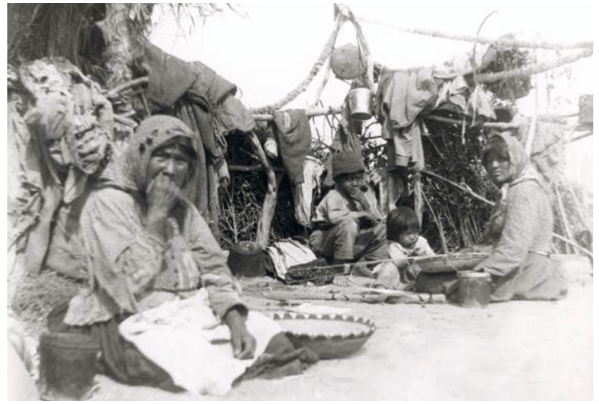
Most Serrano houses were circular domes that had a central fire pit. The homes of several families tended to be clustered in small settlements, and included not only the houses, but also basketry granaries for storage of food, sweathouses, and often a ceremonial house. They were placed near springs or other water sources, and as near as possible to other resources (Bean and Smith 1978).
<< Previous << Contents >> Next >>
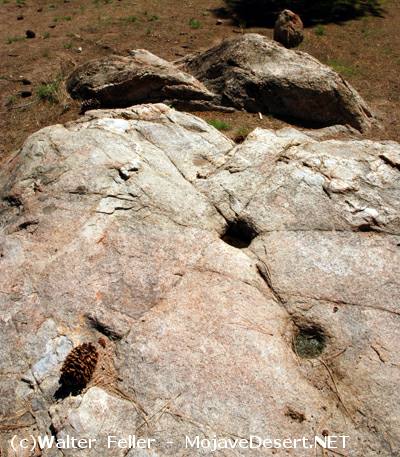
Community mortar stone in forest